
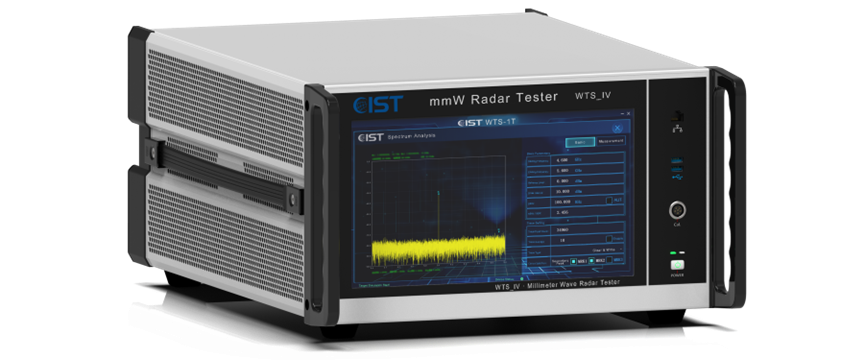
WTS-IV is a comprehensive millimeter-wave radar test instrument that supports target scattering characteristics simulation. It can not only perform radar waveform acquisition, storage, and analysis, RF/antenna performance testing, perception performance testing, and anti-jamming capability testing, but also supports intelligent driving, smart transportation, low-altitude sensing and avoidance, and complex electromagnetic interference scenario simulation. It supports custom target trajectory editing, millimeter-wave radar radiation and antenna modeling, and various interference signal types such as FMCW, PMCW, and clutter, enabling the simulation of realistic complex electromagnetic environments. It comprehensively supports the full lifecycle R&D testing of millimeter-wave radars.
※ Comprehensive Functionality
WTS_IV integrates four core functions: radar waveform analysis, point cloud target simulation, jamming simulation, and scenario simulation. It enables radar perception performance evaluation, anti-jamming assessment, and RF antenna testing without additional instruments, significantly reducing equipment investment.
※ Powerful Target Simulation
Eight independent channels support simultaneous testing of multiple radars. Capable of simulating up to 64 independent targets with target scattering characteristics, meeting diverse mmWave radar testing requirements.
※ Rich Scenario Library
Preloaded with multiple standard regulatory scenarios. Supports customized editing for intelligent driving, smart transportation, low-altitude flight, and complex electromagnetic interference scenarios. Enables radar radiation modeling and antenna pattern configuration, with playback of recorded scene data.
※ Acquisition, Storage & Analysis
Performs real-time analysis of radar modulation waveform parameters while offering offline analysis capabilities through data acquisition and storage.
※ High Extensibility
Over ten optional modules available for on-demand upgrades, supporting rapid offline system expansion.
※ Self-Calibration Support
Optional calibration accessory enables automated product calibration, eliminating the need for periodic factory recalibration.
※ Radar Perception Performance Testing
Enables echo simulation for both point targets and point cloud targets
Conducts testing for radar distance detection range, accuracy, and resolution
Performs testing for radar velocity detection range, accuracy, and resolution
Executes testing for radar angle detection range, accuracy, and resolution
Validates radar maximum detection range
Assesses radar false alarm rate, missed detection rate, and probability of detection
※ Radar Anti-Jamming Evaluation
Simulates diverse jamming scenarios including driving, oncoming traffic, and reversing
Emulates clutter interference environments such as tunnels
Maintains preloaded jamming scenario library
Supports mmWave radar radiation modeling
Integrates multiple built-in radar models
Enables playback of recorded interference data
Facilitates replay of captured radar signals
※ Radar Signal Analysis
Analyzes signal operating bandwidth
Evaluates signal power flatness
Measures frequency modulation slope
Tests pulse modulation parameters (width & period)
Performs radar antenna pattern testing
Verifies transmitter EIRP
Enables radar signal acquisition and storage
※ Traffic Scenario Simulation
Preloaded with multiple regulatory scenario libraries
Supports intelligent driving scenarios
Enables smart traffic ecosystem simulations
Models low-altitude flight perception & avoidance scenarios
Customizes multi-target interaction environments
Maintains extensible target scenario database
Facilitates playback of recorded real-world scenes
Leveraging its professional multi-dimensional target echo simulation, radar radiation modeling, signal acquisition/storage/analysis capabilities, and powerful scenario editing/management functions, the WTS_IV system enables comprehensive applications across mmWave radar deployment domains including intelligent driving, smart traffic ecosystems, and low-altitude flight perception.

WTS-IV Performance Indicators | |||
Type | Metrics | Parameters | Options |
RF Performance Metrics | RF Frequency Range | 24~25 GHz | WTS_IV_LA |
60~64 GHz | WTS_IV_MA | ||
76~81 GHz | WTS_IV_HA | ||
92~94 GHz | WTS_IV_WA | ||
Instantaneous Bandwidth | 1 GHz | WTS_IV_Bm Base Configuration | |
2 GHz | WTS_IV_BW01 Bandwidth Extension Option | ||
5 GHz | WTS_IV_BW02 Bandwidth Extension Option | ||
Power Flatness | ≤ ±1.5 dB, 1 GHz Bandwidth | WTS_IV_Bm Base Configuration | |
≤ ±2.0 dB, 2 GHz Bandwidth | WTS_IV_BW01 Bandwidth Extension Option | ||
≤ ±3.0 dB, 5 GHz Bandwidth | WTS_IV_BW02 Bandwidth Extension Option | ||
Spurious Suppression | ≥ 50 dBc | ||
Input Survival Power | ≥ 6 dBm | ||
Maximum Input Power (Antenna Port Excluded) | ≥ -15 dBm | ||
Maximum Output Power (Antenna Port Excluded) | ≥ 15 dBm | ||
Target Simulation | Minimum Target Distance | ≤ 3m + Spatial Distance | WTS_IV_Bm Base Configuration |
Ignore spatial distance (0m) | WTS_IV_SR Short-Range Option | ||
Maximum Target Distance | 400m | WTS_IV_Bm Base Configuration | |
800m | WTS_IV_DR01 Range Extension Option | ||
1600m | WTS_IV_DR02 Range Extension Option | ||
3200m | WTS_IV_DR03 Range Extension Option | ||
Distance Step | 0.01m | ||
Distance Accuracy | ≤ ±0.02m | ||
Target Type | Point Target | WTS_IV_Bm Base Configuration | |
4 Point Clouds | WTS_IV_SP01 RCS Signature Simulation Option | ||
8 Point Clouds | WTS_IV_SP02 RCS Signature Simulation Option | ||
16 Point Clouds | WTS_IV_SP03 RCS Signature Simulation Option | ||
32 Point Clouds | WTS_IV_SP04 RCS Signature Simulation Option | ||
Target Simulation | Point Target Capacity | 1/Channel | WTS_IV_Bm Base Configuration |
2/Channel | WTS_IV_TN01 Target Capacity Upgrade Option | ||
4/Channel | WTS_IV_TN02 Target Capacity Upgrade Option | ||
8/Channel | WTS_IV_TN03 Target Capacity Upgrade Option | ||
Target Simulation | Velocity Range | ±1000km/h | |
Velocity Step | ±0.01km/h | ||
Velocity Accuracy | ≤±0.01km/h | ||
RCS Dynamic Range | 100 dBsm | ||
RCS Adjustment Step | 0.1 dB | ||
RCS Dynamic Accuracy | ±0.5 dB | ||
Typical Target RCS | 60~20 dBsm@100m, Support the Simulation of Target RCS Fluctuation Characteristics | ||
Waveform Analysis | Time-Domain Waveform Analysis Function | WTS_IV_RSA Option Radar Waveform Analysis Function | |
In-Band Spectrum Analysis Function | |||
Support Real-time Analysis | |||
Support Offline Analysis | |||
Modulation Analysis Function | Pulse Signal Analysis Function | ||
Support Phase Analysis Function | |||
FM Slope Analysis Function | |||
FM Bandwidth Analysis Function | |||
FM Linearity Analysis Function | |||
Acquisition and Storage Function | Supports Radar Data Acquisition and Storage | ||
Scenario Simulation | Embedded Multiple Compliance Test Profiles | WTS_IV_SIM Motion Scenario Simulation Function | |
User-Definable Scenario Capability | |||
Scenario Library Management Support | |||
Multi-Target Trajectory Editing Support | |||
Recorded Scenario Playback Support | |||
HIL Simulation Interface | Hardware-in-the-Loop (HIL) Simulation and Automated Testing Support | ||
Interference Simulation | Interference Signal Types | Noise, CW, Pulse, FMCW, SFMCW, PMCW etc. | WTS_IV_JAM Implement Interference Simulation Functionality |
Pulse Width | 0.1 μs ~ 10 ms | ||
Pulse Repetition Frequency (PRF) | 1 μs ~ 100 ms | ||
Duty Cycle | 1% ~ 100% | ||
Interference Simulation | FM Slope | 1 MHz/μs ~ 100 MHz/μs | WTS_IV_JAM Implement Interference Simulation Functionality |
Maximum Interference Bandwidth | ≥5 GHz | ||
Maximum Interference Power Spectral Density (PSD) | ≥1 million pulses per second | ||
Supports Playback of Field-captured Jamming Signals | |||
Supports Jamming Scenario Configuration and Storage | |||
Interference Simulation | Supports Jamming Scenario Library | WTS_IV_JAM Implement Interference Simulation Functionality | |
Supports Radiation Characteristic Configuration and Storage | |||
Supports Radiation Waveform Configuration | |||
Supports Radiation Pattern Configuration | |||
Self-Calibration Option | The device can be calibrated and a calibration report can be generated without returning to the factory. | WTS_IV_B12 | |
WTS-IV Configurable Options | |||
Option | Model | Function | |
Basic Option | WTS_IV_Bm | The base unit configuration of the product allows integration with standalone transceiver front-ends or array antenna front-ends operating across different frequency bands. | |
24 GHz Transceiver Front-End | WTS_IV_LA | Enables radar signal transmission and reception in the 24 GHz-25 GHz band, supporting up to 8 channels | |
60 GHz Transceiver Front-End | WTS_IV_MA | Enables radar signal transmission and reception in the 60 GHz-64 GHz band, supporting up to 8 channels | |
77 GHz Transceiver Front-End | WTS_IV_HA | Enables radar signal transmission and reception in the 76 GHz-81 GHz band, supporting up to 8 channels | |
92 GHz Transceiver Front-End | WTS_IV_WA | Enables radar signal transmission and reception in the 92 GHz-94 GHz band, supporting up to 8 channels | |
IF Channel Upgrade Option | WTS_IV_B01 | Adding one IF channel enables a single unit to support up to 8 channels, with the maximum channel count varying based on the configured bandwidth | |
Bandwidth Upgrade Option | WTS_IV_BW01 | Upgrades an IF channel to 2 GHz instantaneous bandwidth | |
WTS_IV_BW02 | Upgrades an IF channel to 5 GHz instantaneous bandwidth | ||
Target Range Upgrade Option | WTS_IV_SR | Short-range target option, can ignore spatial distance (0m) | |
WTS_IV_DR01 | Extends maximum range to 800m | ||
WTS_IV_DR02 | Extends maximum range to 1600m | ||
WTS_IV_DR03 | Extends maximum range to 3200m | ||
Target Capacity Upgrade Option | WTS_IV_TN01 | Upgrades a single channel to track 2 independent targets | Each target features independent distance, velocity, and RCS parameters, with a maximum capacity of 64 targets. |
WTS_IV_TN02 | Upgrades a single channel to track 4 independent targets | ||
WTS_IV_TN03 | Upgrades a single channel to track 8 independent targets | ||
Target Scattering Characteristic Option | WTS_IV_SP01 | Supports 4 point clouds | The target type is a point cloud target, with scattering characteristics capable of simulating categories such as automobiles, trucks, pedestrians, and UAVs. |
WTS_IV_SP02 | Supports 8 point clouds | ||
WTS_IV_SP03 | Supports 16 point clouds | ||
WTS_IV_SP04 | Supports 32 point clouds | ||
Signal Analysis Option | WTS_IV_VSA | Performs time-domain, in-band spectrum, and time-frequency analysis, while supporting waveform data acquisition and storage. | |
Scene Simulation Option | WTS_IV_SIM | Features built-in regulatory standard scenarios and supports simulation of complex multi-target scenes. | |
Jamming Simulation Option | WTS_IV_JAM | Supports multiple canonical jamming scenarios, radar radiation modeling, and antenna pattern setup. | |
Self-Calibration Option | WTS_IV_B12 | Offering an optional Self-Calibration Option, the equipment enables on-site calibration execution and traceable calibration report generation without requiring factory return. | |