
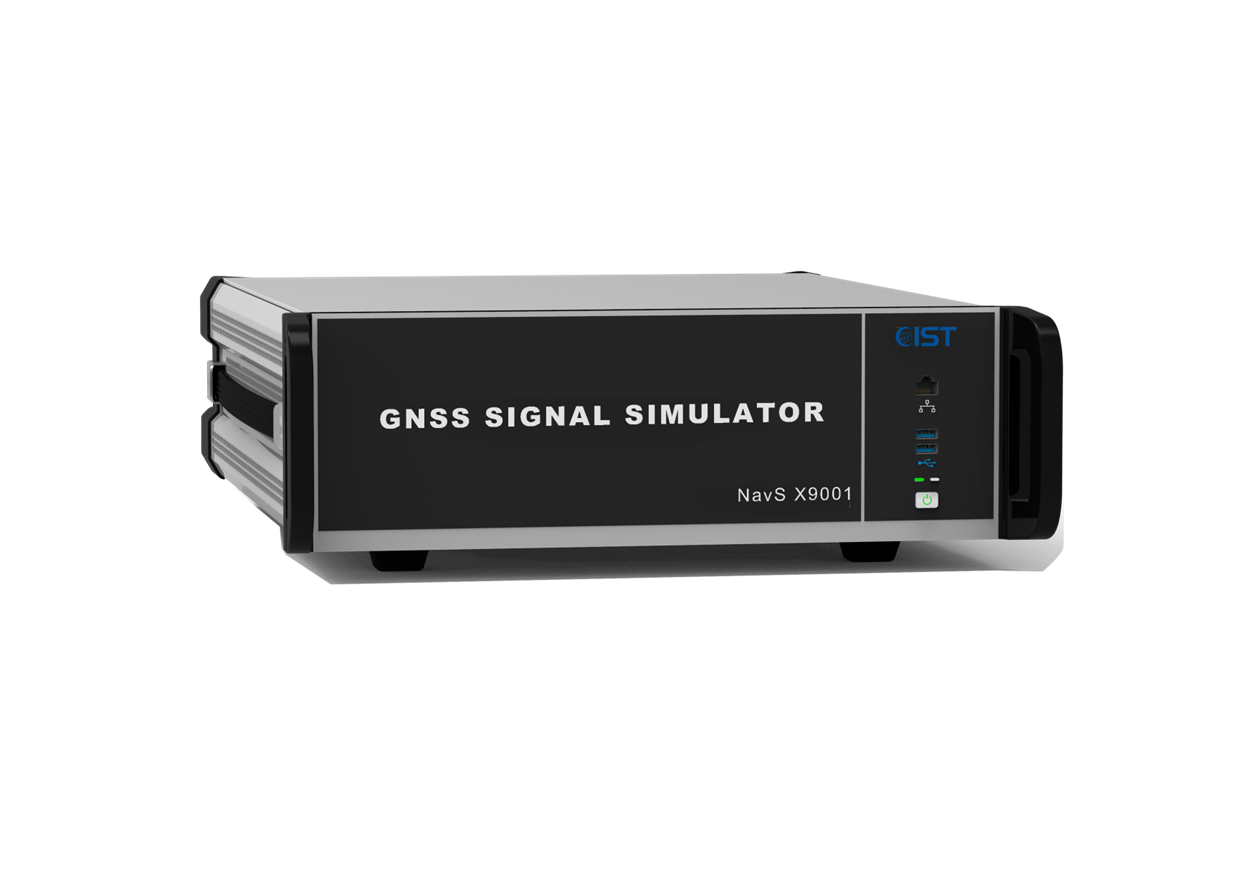
The new-generation global satellite navigation multi-frequency signal simulator enables full-frequency navigation signal simulation, including systems such as BDS, GPS, GLONASS, Galileo, QZSS, NAVIC, and SBAS. It supports dual-user and interference signal simulation and can be used in all stages of navigation chip, module, and complete equipment development, production, testing, experimentation, verification, and maintenance support.
※ Simulation Capabilities
Supporting Constellation Simulation
Supporting Trajectory Simulation
Supporting Environmental Effects Simulation
Supporting Integrated Navigation Simulation
Supporting RTK Simulation
Supporting Antenna Simulation & Modelling
Supporting Anomaly Simulation
Supporting Dual-User Simulation
Supporting LEO Satellite Simulation
Supporting Jamming Simulation
※ Parameter Settings Function
Simulation Time Settings
Simulation Power Settings
Satellite Orbit Settings
Environmental Effects Parameter Settings
Trajectory Parameter Settings
※ Data Storage and Status Display
Support for Simulation Data Export Functionality
Support for Real-time Simulation Status Display
※ Test Mode
Supports Automated Testing Functionality
Remote Control Function
Wired Testing
Wireless Testing
The GNSS signal simulator can be configured for dual-user simulation. Based on simulation time, user trajectory data, and satellite trajectory data, it generates navigation signals and outputs them to the receiver. The receiver subsequently outputs test data. By comparing the simulator’s theoretical data with the receiver’s test data, the performance evaluation of the receiver can be achieved.

NavS X9001 Performance Indicators | |||
Type | Metrics | Parameters | Options |
Constellation and Frequency Simulation Capability | BDS | B1I, B1C, B2I, B2a, B2b, B3I | NavS X9001_BDS_N Frequency Option |
GPS | L1C/A, L1C, L1P, L2C, L2P, L5 | NavS X9001_GPS_N Frequency Option | |
GLONASS | L1C/A, L2C/A, L3OC | NavS X9001_GLO_N Frequency Option | |
Galileo | E1, E5a, E5b | NavS X9001_GAL_N Frequency Option | |
QZSS | L1C/A, L2, L5 | NavS X9001_MIX_N Frequency Option | |
NAVIC | L5 | ||
SBAS | BDSBAS, WAAS, EGNOS | NavS X9001_SBAS_N Frequency Option | |
Number of Channel | Maximum 512 Channels | NavS X9001_Bm Basic Configuration | |
Update Rate | 1000 Hz/500 Hz/200 Hz/100 Hz (default)/ 50 Hz | ||
Signal Power | Power Range | – 165 dBm ~ -20 dBm (per satellite) | NavS X9001_Bm Basic Configuration |
Power Accuracy | ≤0.3 dB | ||
Signal Accuracy | Pseudorange Accuracy | ≤0.01m | |
Accuracy of Pseudorange Change Rate | ≤0.001m/s | ||
Channel Consistency | ≤0.3 ns | ||
Signal Quality | Harmonic Power | ≤-40 dBc | |
Clutter Power | ≤-50 dBc | ||
Signal Dynamics | Simulated Altitude | ≥8000km | |
Relative Velocity | ≥120000m/s | ||
Acceleration | ≥8000m/s2 | ||
Jerk | ≥10000m/s3 | ||
Trajectory Simulation | Static, Low-Dynamic (Vehicles, Aircraft, Vessels, etc.), and High-Dynamic Trajectory (Missiles, LEO Satellites, etc.) Simulation Capabilities | ||
Circular, Spiral, and Other Specialized Trajectory Simulation Capabilities | |||
External Input Vehicle Trajectory File Import Functionality | |||
Real-time Closed-loop Simulation Capability via External Vehicle Trajectory Interface | |||
Integrated Navigation Simulation | INS Auxiliary Data Generation with IMU Error Models | ||
RTK Simulation | RTK Differential, Heading, and Attitude Testing | NavS X9001_RTK Simulation Option | |
Environmental Effects Simulation | Ionospheric, Tropospheric, and Multipath Effects | NavS X9001_Bm Basic Configuration | |
Antenna Simulation Modeling | Antenna Radiation Pattern Parameter Configuration | ||
Anomaly Simulation | Leap Second, Pseudorange, and Power Anomalies | ||
Dual-User Simulation | Simultaneous Simulation of Two Mutually Opposing Users | NavS X9001_2U Dual-User Simulation Option | |
Supports Low Earth Orbit (LEO) Satellite Simulation | NavS X9001_LEO LEO Simulation Option | ||
Jamming Simulation | Barrage Jamming (Up to 6 Channels) | 1.5 GHz Frequency Band: BDS: B1; GPS: L1; GLONASS: L1; Galileo: E1; QZSS: L1; SBAS: BDSBAS, WAAS, EGNOS | NavS X9001_F1_M Frequency Option |
1.2 GHz Frequency Band: BDS: B3; GPS: L2, GLONASS: L2; Galileo: E6; QZSS: L2 | NavS X9001_F2_M Frequency Option | ||
1.1 GHz Frequency Band: BDS: B2; GPS: L5; GLONASS: L3; Galileo: E5; QZSS: L5; NAVIC: L5; SBAS: BDSBAS, WAAS, EGNOS | NavS X9001_F3_M Frequency Option | ||
Spoofing Interference | Position, Velocity, and Time Offset Spoofing | NavS X9001_CH Spoofing Simulation Option | |
Simulation Parameter Settings | Simulation Timeline Settings, Signal Level Settings, Satellite Orbit Settings, Environmental Effects Parameters, Trajectory Parameters | NavS X9001_Bm Basic Configuration | |
Simulation Data Export | Broadcast Ephemeris, Navigation Message, Satellite Operational Status, Vehicle Kinematic State | ||
Real-time Status Display | Satellite constellation, PRN, Elevation, Azimuth, Pseudorange, Pseudorange Rate, Ionospheric Error, Tropospheric Error, Skyplot View, and Motion Trajectory Display | ||
Automated Testing | Equipped with automated test software to perform comprehensive evaluation of navigation terminals, including positioning accuracy, velocity measurement accuracy, sensitivity, and other key performance indicators | NavS X9001_ATS Automated Test Evaluation Option | |
Remote Control | Enables simulation device control via remote software | NavS X9001_Bm Basic Configuration | |
Supports Wired and Wireless Testing | |||
Interfaces | 1PPS Input Interface | BNC*1, 3.3V LVTTL | |
1PPS Output Interface | BNC*1, 3.3V LVTTL | ||
10 MHz Input Interface | BNC*1, 7~10 dBm | ||
10 MHz Output Interface | BNC*1, 10±0.5 dBm | ||
Navigation Signal Output Interface | BNC*1 | ||
Network Interface | RJ45*1 | ||
VGA | 1 | ||
USB | 2 | ||
Other Indicators | Operating Voltage | AC220V | |
Power Consumption | 300W (Typical) | ||
Dimensions | 488mm (W) * 221mm (H) * 549 mm (D) | ||
Weight | 30kg (Typical) | ||
NavS X9001 Configurable Options | ||
Option | Model | Description |
Basic Configuration | NavS X9001_Bm | The main unit’s base configuration supports integration with various frequency options or automated test software. |
Frequency Option | NavS X9001_BDS_N | Generates BDS: B1I, B1C, B2I, B2a, B2b, B3I Frequency Signals |
NavS X9001_GPS_N | Generates GPS: L1C/A, L1C, L1P, L2C, L2P, L5 Frequency Signals | |
NavS X9001_GLO_N | Generates GLONASS: L1C/A, L2C/A, L3OC Frequency Signals | |
NavS X9001_GAL_N | Generates Galileo: E1, E5a, E5b Frequency Signals | |
NavS X9001_MIX_N | Generates QZSS: L1C/A, L2, L5 Frequency Signals | |
Generates NAVIC: L5 Frequency Signals | ||
NavS X9001_SBAS_N | Generates SBAS: BDSBAS, WAAS, EGNOS Frequency Signals | |
RTK Function Option | NavS X9001_RTK | Enables RTK Differential Positioning, Heading Determination, and Attitude Validation Tests |
User Otpion | NavS X9001_2U | Enables Dual-User Testing |
LEO Simulation Option | NavS X9001_LEO | Enables Low Earth Orbit (LEO) Satellite Emulation |
Jamming Simulation Option | NavS X9001_F1_M | Barrage Jamming Testing in the 1.5 GHz Band |
NavS X9001_ F2_M | Barrage Jamming Testing in the 1.2 GHz Band | |
NavS X9001_ F3_M | Barrage Jamming Testing in the 1.1 GHz Band | |
NavS X9001_CH | Enables Spoofing Interference Testing | |
Automated Test Software | NavS X9001_ATS | Enables Command of the NavS X9001 and Automated Evaluation of the DUT (Device Under Test) |
Notes: “N” denotes the number of frequency points. “M” denotes the number of frequency band channels, with a maximum of 6 channels generatable per single unit. | ||