
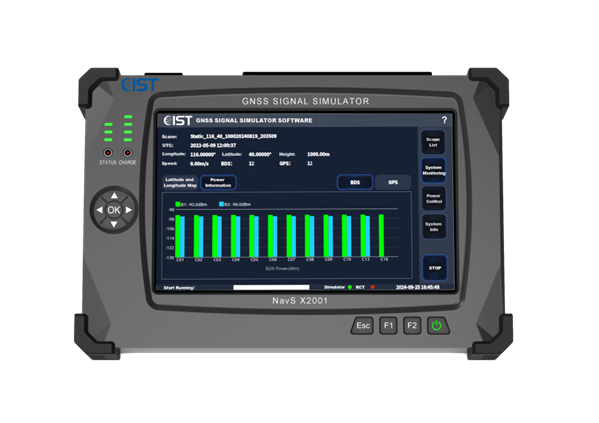
NavS X2001 GNSS signal simulator is a portable simulation device that supports full-frequency simulation and output of navigation signals (including BDS, GPS, GLONASS, Galileo, SBAS, NAVIC, and QZSS). It can also simulate real satellite signals in field environments, satisfying field testing requirements while also enabling quick testing, verification of navigation terminal functionality and performance, and troubleshooting.
Full-frequency Signal Simulation
Supports BDS, GPS, GLONASS, Galileo, SBAS, NAVIC, and QZSS
Sky-Synchronized Functionality
Simulates real satellite signals in field environments, delivering outputs consistent with actual sky signals to meet field-testing requirements
Portable Design
Lightweight and easy to carry, suitable for laboratory, field, or mobile testing scenarios
※ Constellation Simulation: Satellite orbit simulation, satellite clock offset simulation, timing group delay (TGD) simulation
※ Trajectory Simulation: Static and dynamic trajectory generation capability
※ Environmental Simulation: Ionospheric delay simulation, tropospheric delay simulation, ground atmospheric parameter simulation
※ Simulation Control: Independent per-channel pseudorange and power configuration. Navigation message generation for constellation models. Parameter configuration for atmospheric and ionospheric models
※ Data Recording: Storage of observation data and navigation message data
※ Automated Testing Software: Performs automated testing of navigation terminals for: Positioning accuracy, velocity measurement accuracy, sensitivity
NavS X2001 GNSS signal simulator is a portable simulation device that supports full-frequency simulation and output of navigation signals (including BDS, GPS, GLONASS, Galileo, SBAS, NAVIC, and QZSS). It can also simulate real satellite signals in field environments, satisfying field testing requirements while also enabling quick testing, verification of navigation terminal functionality and performance, and troubleshooting.

NavS X2001 Performance Indicators | ||||
Metrics | Parameters | Options | ||
Frequency Point | BDS: B1I, B1C, B2I, B2a, B2b, B3I | NavS X2001_BDS_N | Frequency Option | |
GPS: L1C/A, L1C, L1P, L2C, L2P, L5 | NavS X2001_GPS_N | |||
GLONASS: L1C/A, L2 C/A, L3OC | NavS X2001_GLO_N | |||
Galileo: E1, E5a, E5b | NavS X2001_GAL_N | |||
QZSS: L1C/A, L2, L5 | NavS X2001_MIX_N | |||
NAVIC: L5 | ||||
SBAS: BDSBAS, WAAS, EGNOS | NavS X2001_SBAS_N | |||
Signal Accuracy | Pseudorange Phase Control Accuracy | ≤0.05m | NavS X2001 Basic Configuration | |
Pseudorange Rate Accuracy | ≤0.005m/s | |||
Inter-channel Consistency | 0.3 ns | |||
Synchronization Accuracy | ≤50 ns | |||
Phase Noise | -75 dBc/Hz 100 Hz; -80 dBc/Hz 1 kHz -85 dBc/Hz 10 kHz; -90 dBc/Hz 100 kHz | |||
Output Signal Power | Power Range | -150 dBm ~ -60 dBm | ||
Power Resolution | ≤0.2 dB | |||
Power Accuracy | ≤0.7 dB | |||
Simulation Channels | No fewer than 16 channels per frequency band, plus 4 multipath channels | |||
Signal Dynamics Simulation | Velocity | ≥15000m/s | ||
Acceleration | ≥1000m/s2 | |||
Jerk | ≥1000m/s3 | |||
10 MHz Reference Clock | Input Amplitude | 20 μs±1 μs | ||
Output Amplitude | ≥3V | |||
Signal Impedance | 50±10Ω | |||
Interface | 1*10 MHz Output, SMA | |||
1*10 MHz Input, SMA | ||||
1*1 PPS Output, SMA | ||||
1*RF Output, SMA | ||||
1*RF Input, SMA | ||||
1*Ethernet Port | ||||
Dimensions | 320mm (L) * 200mm (W) * 100mm (H) | |||
Weight | ≤5kg | |||
Operating Voltage Range | 200V ~ 240V/AC, 50 Hz ~ 60 Hz (Power Adapter) | |||
Battery Runtime | ≥3h | |||
Total Power Consumption | ≤80W | |||
NavS X2001 Configurable Options | ||
Option | Model | Description |
Basic Configuration | NavS X2001_Bm | The main unit’s base configuration supports integration with various frequency options or automated test software. |
Frequency Option | NavS X2001_BDS_N | Generates Frequency Signals, BDS: B1I, B1C, B2I, B2a, B2b, B3I |
NavS X2001_GPS_N | Generates Frequency Signals, GPS: L1C/A, L1C, L2C, L5 | |
NavS X2001_GLO_N | Generates Frequency Signals, GLONASS: L1C/A, L2C/A, L3OC | |
NavS X2001_GAL_N | Generates Frequency Signals, Galileo: E1, E5a, E5b | |
NavS X2001_MIX_N | Generates Frequency Signals, QZSS: L1C/A, L2, L5 | |
Generates Frequency Signals, NAVIC: L5 | ||
NavS X2001_SBAS_N | Generates Frequency Signals, SBAS: BDSBAS, WAAS, EGNOS | |
Automated Test Software | NavS X2001_ATS | Enables Command of the NavS X2001 and Automated Evaluation of the DUT (Device Under Test) |
Note: “N” denotes the number of frequency points. | ||